Job Scout: an AI job-search pipeline
Impact overview
Job hunting is a data problem.
I was searching for AI engineering, product and solutions roles. The good ones show up on hundreds of company boards, appear for a day, and are gone. Checking them by hand did not scale, and a plain keyword alert could not tell me which postings I actually had a shot at.
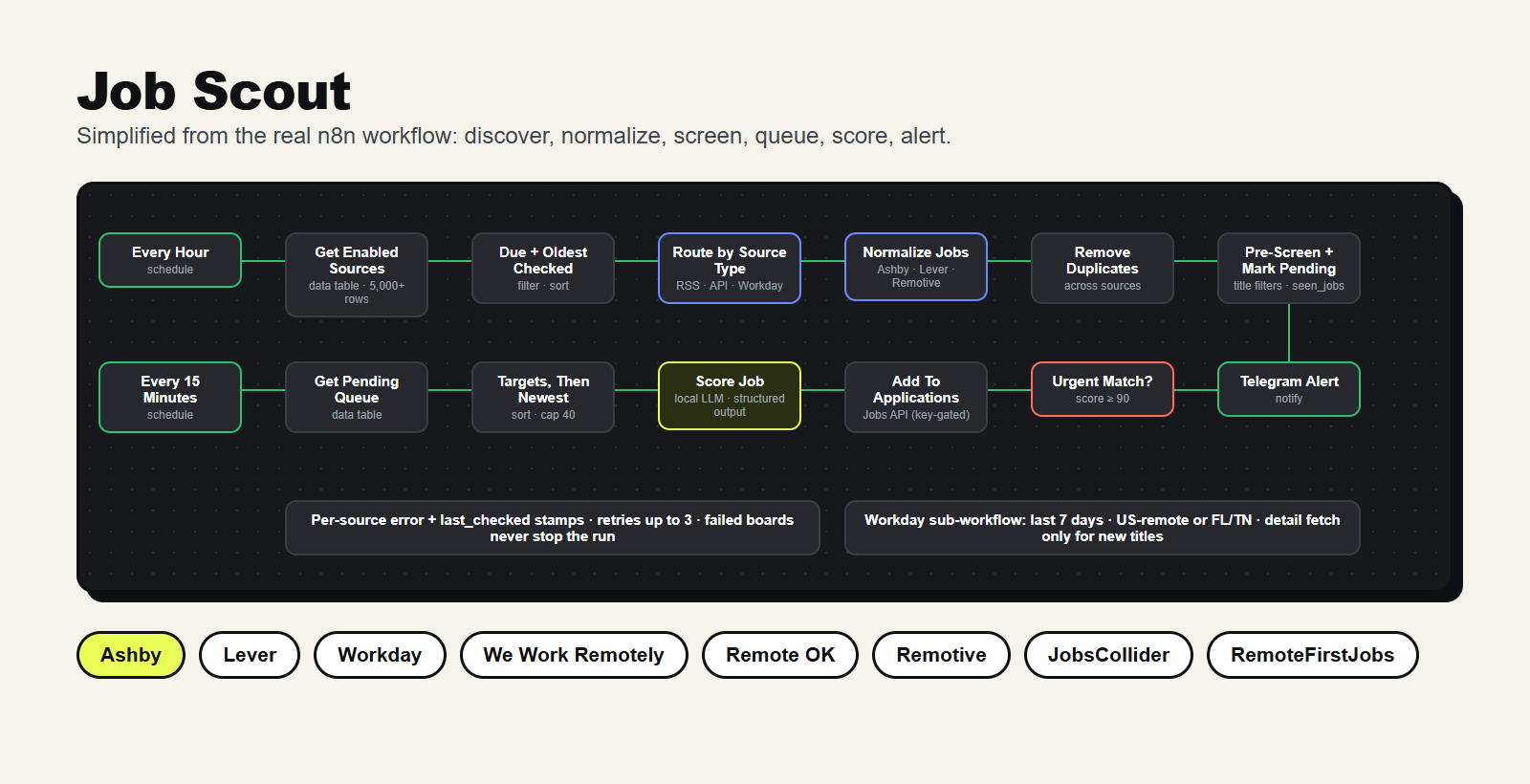
Job Scout is the system I built to fix that. It is an n8n workflow that discovers postings, screens them, scores them with a local language model, and only interrupts me when something is worth acting on.
Too many boards, too little signal.
- Postings are scattered across RSS feeds, public APIs and company-hosted boards (Ashby, Lever, Workday), each with its own shape.
- The same role appears on several boards, so a naive scraper alerts on duplicates.
- Keyword filters surface titles, not fit: they cannot weigh hard requirements, seniority or whether a remote role is open to my state.
- Sending every posting to a hosted AI model gets expensive fast and puts my data in someone else’s hands.
Find the few that matter, automatically.
Run unattended, never score the same job twice, cost nothing per posting, and notify me only on strong matches. Keep every board configurable from a table so adding a source never means editing the workflow.
Two stages, one workflow.
The workflow has two schedules that share one configuration node and one set of tables.
- Discover Pick the boards due for a check, oldest first, up to 150 per run
- Normalize Route by source type and reshape every board into one job format
- Screen Title and location filters, cross-source de-duplication, seen-jobs check
- Queue Mark survivors pending in a data table
- Score Local model rates 40 jobs per run against a fixed rubric
- Save and alert Store through the Jobs API; Telegram alert at 90 or higher
-
Source table, not hard-coded boards
Every board is a row in a job_sources table with its type, feed URL, poll interval and last error. Turning a source off, slowing it down or adding a new company is a table edit. A Switch node routes each row to the RSS reader, an API parser or a Workday sub-workflow.
-
Normalization
Each source returns a different shape. Per-source Set nodes convert RSS items, Remote OK, Remotive, Ashby and Lever responses into one format. Workday runs in its own sub-workflow that pages through the last seven days of postings, fetches details only for relevant titles it has not seen, and keeps remote US roles or roles in my regions.
-
Screening before spending compute
A job gets a stable key, duplicates across sources are removed, a title filter drops irrelevant families, and any job already in the seen-jobs table or already in my applications is skipped. Only new, plausible postings reach the model.
-
Scoring on a local model
A chain node sends each posting to gpt-oss-20b in LM Studio with a low temperature and a structured output parser. The prompt scores how likely I am to get the role (experience match, hard requirements, location eligibility, seniority), not how much I would like it, and returns matched skills, missing requirements, concerns and a one-line reason.
-
Saving, alerts and failure handling
Scored jobs are saved through a key-gated Jobs API webhook. A 409 means the job already exists, so the score is updated and no alert fires. Scores at or above the threshold trigger a Telegram message. Failed evaluations record the error and retry up to three attempts; failing sources store their last error on their own row so one bad board never stops the run.
A second workflow so other agents can use the data.
A separate key-gated webhook workflow exposes the job table to outside agents: list statuses, list jobs, add a job and update a job. Job Scout writes through it instead of straight to the table, which keeps a single place for validation and an access log of which agent did what. It has handled thousands of calls without a failed run.
What it changed.
- Coverage: more than 5,000 boards and feeds are checked on a schedule, far beyond what I could watch by hand.
- Signal over noise: duplicates, irrelevant titles and already-seen jobs never reach the model, and I am notified only on high-scoring matches.
- Cost and privacy: scoring runs on local hardware, so there is no per-job AI bill and posting data stays with me.
- Maintainability: the source table, a single Config node (model, threshold, batch sizes) and sticky-note documentation mean changes are settings, not rewiring.
What I've learned.
- Screen cheaply before you score expensively: deterministic filters and a seen-jobs table did more for throughput than any prompt change.
- Cap every stage (boards per run, jobs per run) so a bad hour cannot snowball into a backlog.
- Ask the model for the question you actually care about. Scoring odds of getting the role, instead of liking it, made the alerts far more useful.
- Give every external source its own error field. Rate limits and layout changes are a normal day, not an incident.
What's next?
- More company-board parsers, with Workday and Lever coverage expanded.
- A weekly sample of scored jobs checked against my own judgement to tune the rubric.
- Reusable pieces (the source table pattern and the scoring chain) packaged as downloadable starter workflows.